Teaching
I seek to reimagine how organizational structures, policies, and practices can create more justice-oriented and equitable experiences and outcomes for all faculty, staff, and students.
Teaching Philosophy
I have taught undergraduate and graduate courses across a range of mediums (in-person, hybrid, and completely online) with consistently strong teaching evaluations. In each pedagogical context, I center the following principles: 1) Student learning; 2) Student well-being; 3) Prior knowledge; 4) Challenging concepts. In order to center learning and not teaching, I work to ensure each individual student is able to be successful through equitable accommodations. For example, I allow students to integrate my feedback on written assignments for a rewrite and regrade to ensure they learn through the writing process rather than just get assessed. In addition, the global pandemic has made it abundantly clear that personal health and wellbeing must be prioritized. I work with individual students to ensure they can be healthy, well, and academically successful.
Through course content, discussion, and activities, I ensure students’ identities, histories, experiences, and perspectives are valued in course discussion and treated with dignity. I also ensure students are challenged with ideas, ideologies, and course material that they may not have been exposed to or agree with. I accomplish this by incorporating course materials and guest speakers who have experience in various institutional types and functional areas and who also have different identities and backgrounds. Creating a classroom (virtual or physical) environment where students feel comfortable sharing and civilly disagreeing creates critical dissonance necessary for deeper learning outcomes.
Teaching Philosophy
In my courses, I use the surrounding community as a laboratory for learning. For example, I taught Introduction to Higher Education at Eastern Michigan University (Winter 2020). During a field trip to Lansing, Michigan, students were able to have individual discussions with state senators from across the political spectrum to better understand differences in policy decision-making. Teaching at George Mason University, located right outside of Washington, D.C., provides ample opportunities for students to interact with policymakers, association leaders, and higher education administrators from various institutional types.
Courses
I have had the privilege of teaching undergraduates to doctoral students at multiple institutions, including teaching fully in-person, hybrid, and fully online courses. Below are some sample courses I have taught.
| Course Title | Instruction Medium | Student Population | Institution | Syllabus |
|---|---|---|---|---|
| Students in Higher Education | Virtual | Doctoral & Master’s | George Mason University | Link to file |
| Policy Studies in Higher Education | In-Person | Doctoral & Master’s | George Mason University | Link to file |
| Organization & Administration of Higher Education | In-Person | Master’s | University of Iowa | Link to file |
| Practicum in Student Affairs | In-Person | Master’s | University of Iowa | Link to file |
| Issues & Policies in Higher Education & Student Affairs | In-Person | Master’s | University of Iowa | Link to file |
| Introduction to the Field of Student affairs | In-Person | Undergraduate | University of Iowa | Link to file |
| Introduction to Higher Education | Hybrid & Online | Master’s | Eastern Michigan University | Link to file |
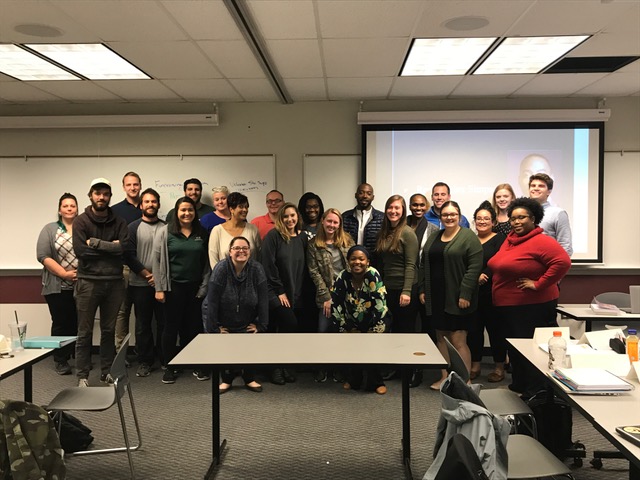
With Guest Speaker EMU Regent Simpson 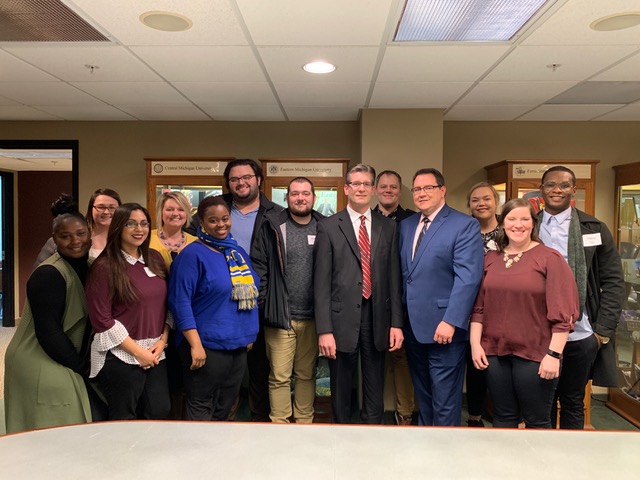
With Dr. Dan Hurley and Bob Murphy from The Michigan Association of Student Universities 
With Local State Senator, Jeff Irwin (D) 
With MI State Senators Jeff Irwin (D) and Dale Zorn (R) in the State Senate Chambers 
U.S. Department of Education Visit 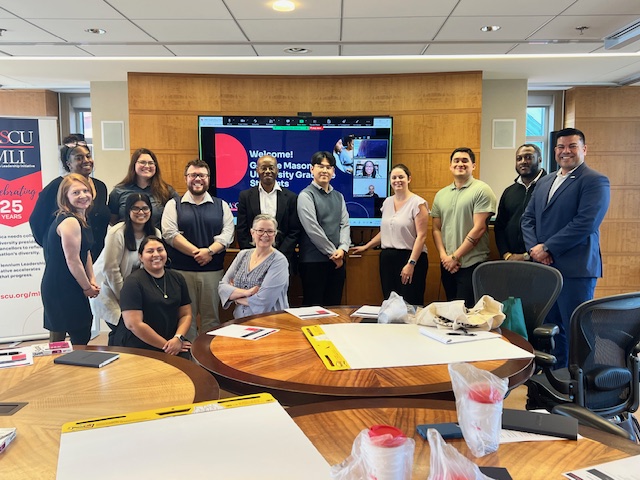
Visit to AASCU DC Office
 Jeffrey K. Grim, Ph.D.